top of page
  • Instagram

ree

This summer I had the opportunity to work as a volunteer at the American Dream Skyranch in South Carolina. The American Dream SkyRanch is home of the renowned vintage aircraft flight school 'Warbird Adventures' by pilot Thom Richard. The school offers Private Pilot, Aerobatic and Tailwheel Training, and much more.


I found out about this place in August 2022 at the New York International Air Show where Thom flew the p40. I was very impressed by his aerobatics and decided to get in touch to explore the possibility of spending the summer working with him. To my surprise, I quickly received a positive response, which was very exciting.


When I arrived at the SkyRanch almost a year later, I wasn’t sure what to expect, but I quickly settled in. I slept above the hangar where I helped repair and maintain vintage aircrafts.

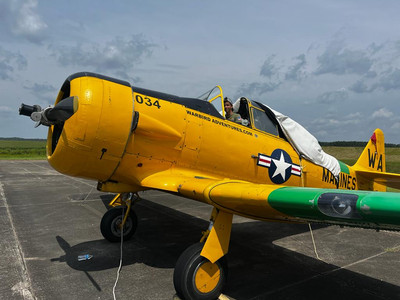

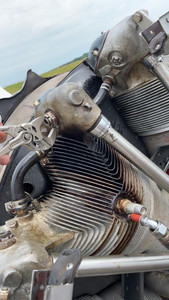
Brian, an aircraft mechanic, showed me the ropes and together we fixed the T-6 Texan engine that had suffered a broken exhaust and had oil leaking from the cylinder. After we fixed it, we did some runups to make sure it operated well. We also replaced the p40 radio, which was pretty cool, and I changed the tires and brakes of a T-6 Texan and organized its documents.


ree

Thom Richard is currently also widening his runway to be able to land bigger aircrafts in the future, and I helped to move dirt and rocks with the use of tractors and diggers from the morning to the evening. I wanted to help in any way I could, so I completed lots of different tasks, including welding to repair a truck.

I really enjoyed the experience, because we worked hard, but the atmosphere was very friendly, and the team felt like family. I was able to get to know everyone and had a great time during and outside of working hours. We even went water skiing on the weekend one day!


I got the opportunity to fly a Citabria and do aerobatics in a Decathlon with Michaela Satter aka “Mac”. Mac is a certified flight instructor for Warbird Adventures, where she teaches primary instruction in a 7KCAB Citabria, beginner and intermediate aerobatics in the 8KCAB Super Decathlon, and warbird operations in the WWII "Pilot Maker," the T-6 Texan.

It was a truly awesome experience and one I won’t forget any time soon!


Spending a month at the American Dream SkyRanch showed me a side of the aviation business that I knew little about and taught me more about the world of aerobatics and vintage planes. I now have a new fascination for warbirds and would love to pursue more advanced training in aerobatics.

If you’re interested to learn more about the American Dream SkyRanch, check out their website: https://www.warbirdadventures.com/

Taking a course there and flying in one of the warbirds will definitely be a unique aviation experience!

If you’d like to see Thom flying in one of his upcoming airshows, you can also check out his schedule here: https://www.warbirdadventures.com/airshows


ree

This week I interviewed Ms. Lyndse Faith Costabile. She has been working with the aviation industry for many years, focusing on management & nonprofit leadership, coaching, team building, philanthropy, and top-level fundraising.


Interested by her career path, I asked her if she would be willing to share with me why she chose to go into entrepreneurship and business in aviation.


Ms. Costabile, could you please start by introducing yourself and letting us know how you first got into aviation?


My story is a little different from many others in the industry. I wasn't born into aviation. My parents and immediate family were not at all involved in aviation. My mother thought being a pilot was a man's job, so I didn't have a lot of internal family support to pursue my passion for aviation. When I was in college there was a flight school nearby, which is where I started training. But it wasn't until I moved to Florida in 2007 that I started advancing more in my flight training journey and getting more access to flight instructors.


I chose flight to pursue a path in general aviation (GA), not professional. The goal was to utilize aviation as a form of private transport from point A to point B. I wasn't very consistent in my flight training, so now I always tell young people: don't do what I did! I wish I would have had someone back then mentoring me to say "Stick with it. Stay consistent. Be persistent. Follow through. Earn those ratings. Don't stop." But I just didn't have that mentorship, which is why today I try to support and mentor youth and young professionals, especially those who may not have someone in their corner.


You studied Business Administration and Marketing in college. What made you go into business in aviation?


I have a business entrepreneurial mindset. The spirit of running businesses, owning businesses, and starting businesses has captivated me at a young age. I was always that kid that was figuring out how to build things and start new goals to achieve. My undergrad was focused on marketing with a minor in psychology, which very much applies to what I do each day. The human mind and human factor are complex. How people think, behave, and react to situations and opportunities is quite impressive. My focus was the study of human behavior and boy, am I able to apply those teachings today! I also wanted to help others, serve people, and initially I thought that maybe the medical path would have been the way to do so, but then I quickly realized that was not for me.


Initially, I didn't get into the aviation business. I first had a career in higher education for 18 years, focused on fundraising, corporate relations, and development, including a tenure at Embry-Riddle Aeronautical University (ERAU). That is what kept me in aviation, because I was still in contact with aviation companies, aircraft owners and operators throughout. And I would stay consistent and current with different airframes, attending airshows, events, and conferences around the industry.


You are now the President and CEO of FunD Av Consulting. Can you tell us a little bit more about what you do?


Yes, sure! So, we started the company a little over five years ago, in early 2018. It came shortly after I helped lead Dreams Soar, Inc. (DSI), which was established by Shaesta Waiz. In October 2017, Shaesta became the youngest female pilot to circumnavigate the globe in a single engine aircraft and the first Afghan-born to do so. Once we had Shaesta and the airplane back in once piece, and I was able to break a little from my full-time career, it was time to get back into a paying job! Early 2018, I had a discussion with Mr. Jerry Holland, founder of Sheltair who over time, taught me so much about business ownership in aviation. It is thanks to his mentorship that I started the company once I returned from our talk at Sheltair headquarters in Florida. I combined all my experience around high-level fundraising and nonprofit management, media, and public relations, working in the entertainment industry, business aviation, and used it to create FunD Av Consulting. We work on tons of unique projects and programs. For example, right now we are working on the restoration of President Dwight D. Eisenhower’s Lockheed VC-121 Constellation, “Columbine II,” which was the very first Air Force One! It gained global attention when our client, Dynamic Aviation, saved it from ruin in 2016, rotting away in Arizona. Together, we will return this national treasure to the skies in a few years!


We also have full oversight and management of the D-Day Squadron and DC-3 Society. Several members of our team run this organization that commemorates the greatest generation of our time, particularly those that served in World War II. Come May 2024, we will launch from the Northeast United States for the Legacy Tour commemorating D-Day 80 and Berlin 75 anniversaries. We are an organization that preserves history and a DC-3 Society which was born to organize the collective efforts of DC-3 owners, enthusiasts, pilots, mechanics, and operators. The legendary Douglas DC-3 is universally recognized as the greatest airplane of its time. The first DC-type airplane was built in 1933, and in 1941, a modified version of the DC-3 was chosen by the United States Army Air Forces as its standard transport aircraft. Many different variations were made and used during World War II, but the C-47 is most recognized because of its important role in the invasion of Normandy that would spark the end to the War in Europe.


We also support an organization called I Hart Flying Foundation (IHFF). They assist women of all ages in achieving their aviation career goals through the awarding of flight training scholarships while inspiring, educating and mentoring through their aviation journeys and connecting them with industry professionals. We head to Denver on August 18 to complete outreach and events around scholarship fundraising. We invite everyone to a fun event on National Aviation Day (August 19) with IHFF’s partner, FlyteCo Tower, as we are also celebrating their one-year anniversary! They are hosting IHFF at this event to raise dollars for Hart Scholarships and Outreach Programming.


We have lots of other great projects that we support in aviation and the nonprofit world. We support quite a bit of youth outreach and programming. We also have a program called From Sacrifice to Soaring.” This program aims to serve, connect, and transform the lives of people who have faced tragedy, adversity, and obstacles in the past (such as domestic violence or child abuse). Using our flying platform, we help them change their mindset from victim to survivor, and more importantly, go from ‘sacrifice’ to ‘soaring!’


In the past, you have also been involved in the travel/tourism industry. How did you get into that?


So, I ran a travel company called Costabile Travel years ago. As an entrepreneur, I got involved in the travel industry, because then it was a $7 billion-dollar industry, projected to grow exponentially at the time. Now, it’s a $2.29 trillion-dollar industry. I used to help clients book their vacations, honeymoons, business travel, etc. and up to today, people still contact me frequently for help to organize their travels, even though I no longer have the company.


I have always had an adventure mindset, and I have always loved the idea of travel. I didn't grow up with a lot of means, and I started working and making money at the ripe age of ten…and yes, I got paid! My parents taught me that I had to go out there and work to achieve my dreams, and I am grateful for those lessons, because I did what I could to set myself up for success. I also surrounded myself with people with a similar mindset. It’s critical who you hang out with, and who you spend your time with.


Today, many young people don't necessarily have that work ethic. Sometimes they are entitled and want things handed to them without earning it. "Work? What is that??" So, my advice is: Go out and work, get off your bottom and devices, learn how to be around other people, and how to work in a team environment. I don't care if it's working at a fast-food restaurant or cleaning houses; it will teach you absolute valuable skills. I did it all and still today, I humble myself doing jobs not everyone is willing to do – but are necessary. It builds character and discipline – two things we need more of today. I’d also advise parents to be more ‘parents.’ If you coddle your child or act as their ‘friend,’ they won’t ever respect you nor will they know how to survive in the real world.


I’ve held lots of different jobs and internships, which has allowed me to meet important people. And based on my work ethic, they started entrusting me with more responsibilities, which enabled me to move to the next level. I purposefully put myself out there and in front of companies, attended events and invested in conferences to show up, be present, and it rewarded me with where I am today.


What skills have been most important to you in your career? You obviously already touched upon your work ethic, but is there anything else that has been pivotal for you?


Not being entitled and being humble is important, I think. The other thing I would add to that is persistence, and not giving up in the face of adversity. I don't want to devalue higher education, but in my experience sometimes being street smart, hard-working and persistent is more valuable than any college degree.


How do you see the future of business in the aviation industry?


Constantly growing. That was very evident to me during COVID. I have witnessed a significant uptick in companies moving towards owning and operating aircraft. That means more economic development and jobs in a thriving sector.


There is so much to do in the aviation industry. And I think we need to do a lot better in educating people about all the different business sectors and career opportunities within aviation. When I tell people that I work in aviation, they often ask me: "So, are you a flight attendant?”, or ‘What airline do you work for?” because people don't realize all there is to do in aviation. There’s a plethora of opportunities for young people like you, so be open-minded and when you meet people who provide you with advice: listen, absorb, take it all in. I wish I would have had that type of mentoring when I was younger.


Thank you so much for taking the time to do this interview and for your valuable advice. I have learned a lot from you as I did not fully realize either how big of an industry aviation really is. You have definitely inspired me to think more out of the box and explore different career opportunities! Thanks a million.


ree

This week, I am participating in the Rice University Aerospace and Aviation Academy, where I have had the extraordinary opportunity to meet Mr. Leroy Chiao. Mr. Chiao is a former NASA astronaut and International Space Station commander, an instrument-rated pilot, PhD in chemical engineering, co-founder and CEO of OneOrbit, executive coach and motivational speaker, and the list goes on and on... His CV is just mind-boggling and Mr. Chiao has been the recipient of numerous honors and awards for his outstanding achievements throughout his career.

He very kindly accepted to respond to my questions about his inspiring career path and about how he became an astronaut.


Mr. Chiao, you studied chemical engineering in college and pursued a PhD degree in that field. Why chemical engineering? What motivated you?


I was originally interested in electrical engineering. But, once I got to college, I found that I had more interest in chemistry. So, I went into that field. I knew that NASA didn’t care too much about what one specifically studies. NASA requires a Masters degree in a technical or science degree, or a medical degree.


Did you already have a strong interest in aviation or aerospace as a student?


Yes, I was always interested in airplanes and flying, and rockets too.


How did you get into aviation? What types of aircrafts did you fly?


I built and flew many model airplanes and rockets as a kid. In graduate school, I went to the local airport and earned my private pilot’s license.


How did you become a NASA astronaut?


I earned the qualifying requirements and simply applied to NASA. I was fortunate enough to be asked to interview, and then to be selected!


You have been part of four different space missions. Could you tell us a little bit about the experience of spaceflight? What was it like? What was your role during these missions? What has been the most memorable moment for you?


Spaceflight is a surreal experience, especially doing spacewalks. It is almost like being in a dream. I was fortunate to have done different things during my missions. On my first, I did scientific research. On my second, I did my first spacewalks. On my third, I led the spacewalk team to help build the International Space Station (ISS). On my fourth, I flew with the Russians on a Russian rocket and spacecraft, and was the commander of the ISS. I also did two Russian spacewalks.


Probably the most memorable moment was during my third mission. I was doing a spacewalk, and my boots were locked into the robotic arm. While I was being moved from one ISS worksite to another, I was face down to the Earth for several minutes. I had no view of the Space Shuttle, or the ISS. I felt like a satellite flying over the Earth. It was really fantastic.


Was your background in aviation of any use in preparation for your space missions?


Yes, in the sense that if you learn to fly airplanes, you learn to think operationally. That is what makes a good pilot. You are able to keep calm and assess situations, and react appropriately. So, flying airplanes helped prepare me for spaceflight too.


You co-founded OneOrbit. Can you tell us a little bit about the company?


I founded OneOrbit with Jami, who was a professional educator. We do motivational speaking and training, for both corporate and sponsored education events. We use the exciting backdrop of spaceflight to motivate people, and draw lessons learned from spaceflight for topics like leadership, combating complacency, and thinking about applying technology and innovation.


What advice would you give young students who wish to pursue a career in aviation or aerospace?


Keep moving forward! Work hard and do as well as you can in school. Study something for which you have passion. Don’t forget to keep your body and mind healthy too, by choosing a lifestyle that is conducive to positive health.


Thank you so much for your time, Sir. It's been an incredible honor!


ree


bottom of page